Baby Sleep Cycles: One Common Reason Babies Wake Frequently at Night
“Why is my baby waking every hour?” Understanding newborn and infant sleep cycles, frequent night wakings and sleep transitions.
Published May 2026
By Hermes Lu
Introduction
In this article, I will be explaining the science behind the development of newborn and infant sleep and how that relates to one of the most common reasons behind frequent night wakings in babies: the inability to self-soothe and transit sleep cycles.
I find that the process of helping a child to learn to self-soothe and sleep independently can be daunting and uncertain for many parents and that it really helps to understand the developmental reasons why you may choose to help your child learn how to sleep independently, as that will provide parents assurance throughout the process and to remain consistent.
I will also be linking relevant infant sleep research and Singapore child health advisories at the end of this article so that you know that the recommendations included here are safe, evidence-informed and aligned with broader infant and child health guidelines.
It is important to note that this article covers one of the most common reasons as to why babies wake several times a night, but that individual sleep development is highly nuanced and there often can be many other contributing factors in a real-life situation as well. The key is to observe your child’s individual sleep patterns, their moods and their behaviours when they are awake and sleepy, and to evaluate based on your particular child instead of trying to fit a single explanation onto them.
The Development of Sleep and What “Sleeping Through The Night” Really Means
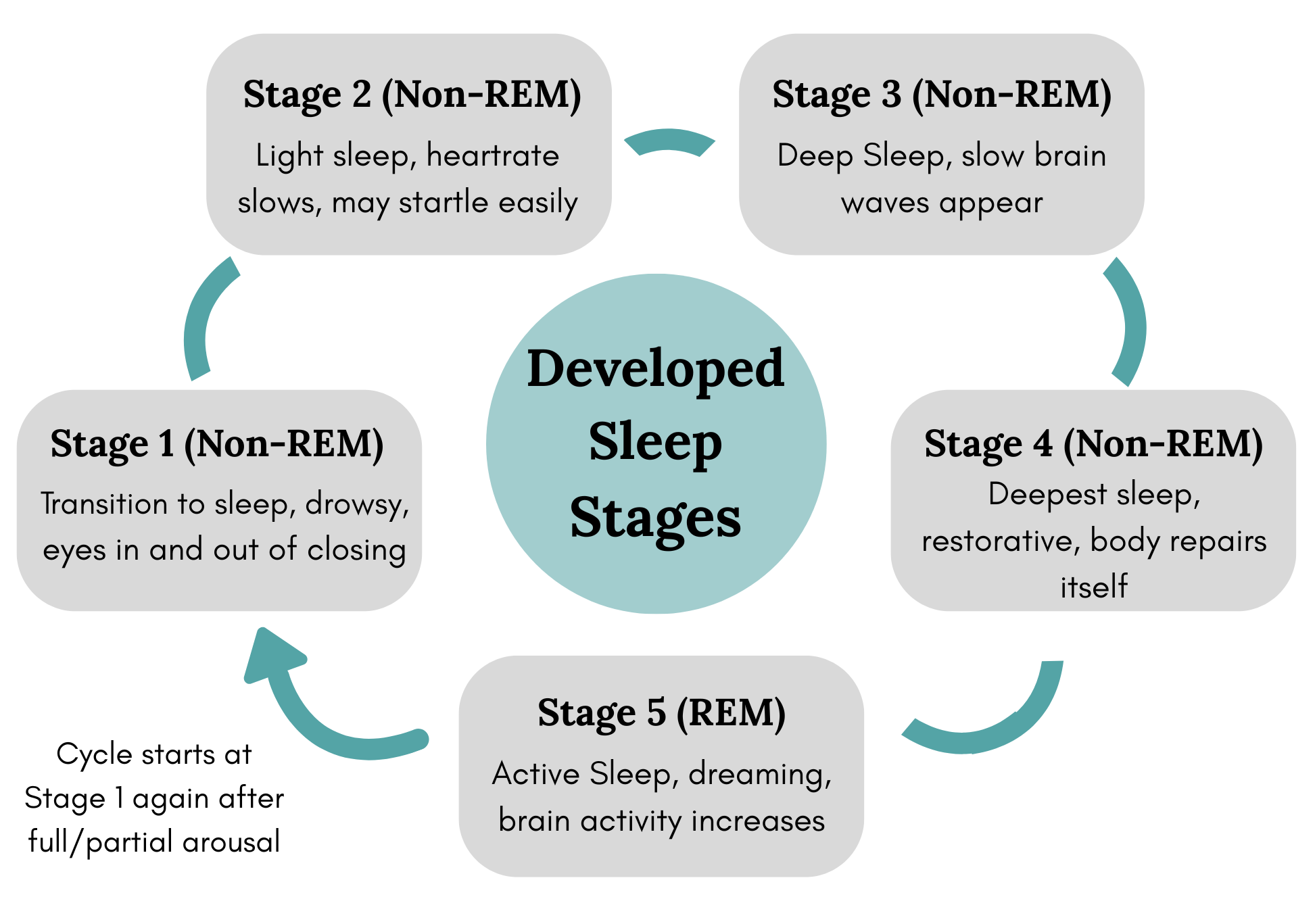
There are five stages of sleep: four stages of non-REM sleep and one stage of REM sleep.
The first stage of non-REM sleep is very light and is usually characterised by drowsiness, and the eyes may also be in and out of closing.
The second stage is where the body starts to disengage from surroundings and body temperature drops, but sleep is still light. At this stage, you would still typically startle easily.
The third stage is a deeper and slower wave type of sleep where you would probably wake up confused and groggy, whereas the fourth stage of sleep is the deepest and most restorative for the body.
Stage five, REM sleep, is a light but active sleep where dreaming occurs. The stages do not necessarily go in order, however, after stage five (REM sleep) the cycle starts again at stage one and there might be full or partial arousal at this point.
Adults go through approximately about 4-6 of such sleep cycles a night, and as an adult, you would probably somewhat aware of yourself tossing and turning a little or waking very slightly several times a night during this transition from stage five to stage one of sleep. This transition is often semi-conscious and you probably would not even pause to think about it on a normal day.
Babies also have to learn how to transit sleep cycles independently in order to get a full night’s rest, meaning they too have to learn how to move from REM sleep back to non-REM sleep by themselves. When we talk about babies “sleeping through the night”, people often misunderstand that it means an infant is able to sleep for long stretches without waking up at all.
The truth is, babies who are able to “sleep through the night” do in fact wake up frequently in between sleep cycles as everyone else does, the difference is that when they have learnt to put themselves back to sleep, they are often able to toss and turn lightly just like adults do and go back to sleep on their own.
When babies wake in between sleep cycles and are unable to transit independently (meaning they do not know how to fall back asleep by themselves), they would then usually cry out for help to go back to sleep. This is what commonly results in babies waking up several times a night in repetitive cycles to cry until they are helped back to sleep, which can be very exhausting and overwhelming for parents.
When they are repeatedly helped back to sleep through rocking, carrying, patting, or any other type of adult intervention, they may become dependent on that intervention to fall back asleep as that is the only way they know how, these interventions are sometimes known as “sleep associations”.
I would like to emphasize however, that it is a myth that we should be refraining from offering comfort to our babies and infants through holding them, carrying them or soothing them in any way. What we should refrain from is to use those interventions to put them all the way to sleep or to transit sleep cycles. It is perfectly good and fine to comfort your baby as much as you want and however much they need, as long as you are not using it to help them go from awake to stage one, or stage five to stage one of sleep.
Babies of course desire and need that gentle assuring touch from their caregivers, and it is also completely natural to want to give it to them, you do not have to fight that instinct.
Developmental Considerations from Newborns to Infants
Newborns in the first three months of life do not yet have five distinct stages of sleep, instead they move between bouts of “active” (REM) and “quiet” (Non-REM) sleep and spend approximately 50% of time in REM and 50% of time in Non-REM. In comparison, adults spend 25% of time in REM and 75% of time in Non-REM sleep. Newborns also have more sleep cycles of active and quiet sleep than adults do. Their sleep patterns are also not established yet at this stage and tend to be more unpredictable.
A duration of a sleep cycle for adults is approximately 90 minutes, whereas for newborns it lasts about 30-50 minutes.
At the newborn stage, causes of frequent night wakings can also be due to hunger, the “startle reflex” also known as the moro reflex, or day and night confusion due to an underdeveloped circadian rhythm. These are all normal, as your baby at this stage is still adjusting to life outside of the womb.
In this stage at the first three months of life, it is recommended to have more gentle, foundational type of environmental and routine-based adjustments to help build healthy sleep and to prevent future feed-to-sleep associations from forming. This is because babies under three months of age are simply not developed enough for more structured or targeted type of sleep training, doing so would be inappropriate. There are practical ways to manage aspects of newborn sleep that can be challenging for parents while allowing your newborn’s body to develop naturally.
You may try to start to cultivate the habit of allowing your newborn to get used to lying down in their own crib space alone, but only as much as they are able to tolerate while remaining calm and neutral. We do not want to create negative associations to their sleep space by enforcing it on them so early on, and again it is also way too early on in their development to do this in an overly structured manner.
While sleep is closely related to feeding at the newborn stage, it is also crucial to never resort to withholding feeds from your newborn in an attempt to improve sleep. General advice from medical guidelines is to always to follow your newborn’s hunger cues and when in doubt, always consult your baby’s paediatrician.
As your baby grows, their sleep cycles develop to be more similar to that of adults. By 6 months of age, babies will spend about 30% of their time in REM sleep and by the preschool ages, the duration of their sleep cycles would have extended to about the same as adults.
At around 4 months of age, babies go through significant sleep maturation due to brain development, this is natural and good and shows that your baby is developing well. This is when we would start to see the forming of more distinct sleep cycles and sleep stages in your baby, and you may notice more regular patterns of lighter sleep and deeper sleep in your child, even during naps. This is actually also when parents might report frequent night wakings happening in cycle-like intervals, which may not have been happening before.
Frequent night wakings due to the inability to transit sleep cycles independently become more prominent at this point forward. At this stage onwards, we can then look at helping infants learn how to self-soothe and to fall asleep by themselves more intentionally, this skill is what will help them to transit sleep cycles on their own. I would always recommend an approach that is responsive and tailored to where the child is at developmentally as a whole, as sleep cycles are but one aspect of sleep development.
Taking into consideration where an individual child is at developmentally in refining our approach is the right thing to do, and also in line with child health advisories which I will elaborate more on below.
Learning how to Sleep Independently and Self-Soothe
Local guidance published by SingHealth recommends placing newborns (1-2 months) on their backs and in their cribs drowsy but awake to encourage them to fall asleep on their own, and to encourage infants (3-11 months) to put themselves back to sleep during the night when they wake by refraining from allowing them to get used to parental assistance at bedtime.
“Drowsy but awake” simply means the child is calm and ready to sleep but still clearly awake, as if they are drowsy but their eyes are already in and out of closing they might already be in stage one of sleep and not actually awake.
Guidance from the National University Hospital (Singapore) on infant sleep hygiene also suggests avoiding feeding babies to sleep as a regular habit once they are older (above 2 months), as this may lead to stronger feed-to-sleep associations over time.
You can be assured that the concept of helping your child fall asleep independently is well-researched and safe to do. What is important however, is the manner in which we choose do so.
There are many sleep training methods out there which target to wean babies off sleep associations and help them learn to sleep independently, from a drowsy and awake state to an asleep state on their own. Some examples are, gradual interval type of methods, reducing sleep association type of methods, and extinction type of methods that require you to leave your baby alone in the room.
I would always recommend that you choose a method that you are most comfortable with, that suits your child’s temperament and developmental needs best, and that is realistic for you to remain consistent with. Observe your child’s sleep patterns and how they are responding along the way.
The goal is to help the child learn the skill of going from drowsy and awake to sleeping on their own, and at the end of the day, methods are methods and should be there to support us in getting there instead of making us feel trapped or restricted. We should not get carried away with pushing through with a method that does not seem to be working, or to feel discouraged if a particular child does not fit into a single method. No two children are the same, just as no two families are the same.
On that note, it is also important that in focusing on helping your child to self-soothe, we do not neglect other areas of sleep development.
Other Aspects of Sleep Development
Other areas of sleep development include sleep pressure, hormones, brain waves and circadian rhythm. These influence other aspects of a baby’s sleep such as their ability to recognise day and night, getting sleepy at the same consistent timings each day, and how long they are able to stay awake before their bodies are ready for a rest.
For example, if a baby is overstimulated due to daytime routine and finding it very difficult to fall asleep due to that reason, leaving them alone in their room for hours to cry in order to learn to self-soothe would only result in prolonged distress and delayed results.
Another example is, if a child is developmentally ready to stay awake for approximately four hours at a time, but is in the middle of a nap transition and being put to sleep every three hours, this may result in the child not having enough sleep pressure to fall asleep at the chosen time of sleep training. Similarly, leaving the child alone in their room for hours to cry in order to learn to sleep independently in a situation like this when their bodies are not ready to sleep, would result in unnecessary distress and delayed results.
We should always look at a child’s overall development, daytime activities and night-time routines as a whole alongside helping them to sleep independently.
It is for this reason that as a practitioner I do not use or recommend full extinction methods (leaving a child alone in the room for several hours to cry it out) with my clients. The nature of doing so is more likely to leave us less attuned to other aspects of a child’s sleep development that we may be missing.
In situations where children actually do better alone in their room during sleep training (some children actually get more distressed when their parents are in the room but not putting them to sleep), I would usually recommend more gradual interval type of methods where we leave the room to allow the child to self-soothe, but still monitor them closely behind the door and enter the room periodically when needed.
If you are currently navigating frequent night wakings and would like more individualised support, you may explore my sleep consultation services here.
References:
Sleep Development & Cycles
Jenni, Oskar & Dahl, Ronald. (2008). Sleep, cognition, and emotion: A developmental view.
Infant Sleep Guidance (Singapore)
National University Hospital (Singapore). (2021). Sleep hygiene in children.
Singapore Medical Association. (2024). Maternal and child health guidelines.
Singhealth. (2026). Sleep (child).
Written By:
Hermes Lu
ECDA-Registered Early Childhood Professional in Singapore
Certified Infant and Child Sleep Consultant
Hermes Lu has 17 years of experience working with infants, children and families in Singapore. She holds a Bachelor’s Degree in Early Childhood Education, ECDA-recognised qualifications for the teaching and care of infants from 2 months of age to 6 years, and is a Certified Infant & Child Sleep Consultant and Newborn Sleep Specialist through IPSP.